

Prime Minister Mark Carney responded to U.S. President Donald Trump’s recent remarks labeling Canada’s pursuit of a closer relationship with the European Union as “laughable.”
During a news conference on Thursday, Carney emphasized that partnering with the EU would enhance Canada’s role as a “better partner” for the U.S., while affirming the necessity of maintaining Canadian independence in the relationship.
In response to Trump’s statements, he remarked, “We are seeking partnerships that complement our sovereignty and reinforce it.”
Carney added, “Canadians stand united in that no one will dictate our language, our culture, or the international agreements we pursue.”
As he aims to strengthen ties with Europe amidst an ongoing trade conflict with the United States, Carney made his comments following a speech to the European Parliament in Strasbourg, France, on Thursday morning.

Prime Minister Mark Carney, speaking to the European Parliament, asserts that an alliance with the EU will enhance sovereignty while ‘allowing us to live our lives as we choose.’
While Carney did not directly mention Donald Trump, he referenced the president’s strategies in his address. He reiterated his earlier comments from Davos, suggesting that economic integration has often been leveraged and indicating that Europe could serve as a more dependable ally.
“We are not fair-weather partners. We do not engage in zero-sum negotiations,” Carney stated. “We share common values for which we have always fought and must remain vigilant in defending.”
When asked about Canada and the EU’s efforts to enhance their partnership, Trump dismissed the notion as “laughable” and warned the EU of “very serious tariffs” if it pursued a trade agreement with Canada “with bad intentions.”
As Carney began his address, Siegbert Droese, a member of the far-right Alternative for Germany party, shouted “U.S.A., U.S.A.!” prompting laughter from Carney and boos from others in attendance.
In comments to CBC News, Droese explained that his outburst was meant to address the “geopolitical elephant in the room,” asserting that the U.S. remains Europe’s most significant trading partner.
He criticized European Commission President Ursula von der Leyen’s suggestion of “associate EU membership” for Canada as “absurd and unrealistic,” emphasizing that such status is not defined in any EU treaties. He expressed his affection for both American and Canadian people.

U.S. President Donald Trump threatened the EU with ‘very serious tariffs’ if it makes a trade deal with Canada ‘with bad intentions.’
Carney advocated for an “alliance of the future” between Canada and the 27 EU member states.
“Canada and the EU together can establish a foundation to uphold our values while creating a protective framework for our citizens to prosper,” he remarked.
“This pertains to sovereignty, our right to live as we choose, and the freedoms that require our constant defense. True sovereignty demands resilience — the capability to endure shocks.”
-
What we know about the proposed partnership between Canada and the EU
-
Q&A
Canada is ‘the most European of non-European countries,’ says Stéphane Dion
In his address, Carney criticized Trump and other dominant powers, suggesting that a partnership between Canada and the EU could serve as a “beacon for other democracies.”
“Let me clarify what I am not advocating. I am not suggesting the creation of a third bloc to compete with great powers, albeit with better decorum,” he stated.
“Our aim is not to gain power to control others. Rather, we seek resilience so that our open markets remain free from control, our sovereignty intact, and our freedoms, democracies, and rule of law safeguarded.”
In the past year, Canada has established multiple new partnership agreements with the EU and was the first non-European nation to join Security Action for Europe (SAFE), which allocates €150 billion in loans for defense initiatives.
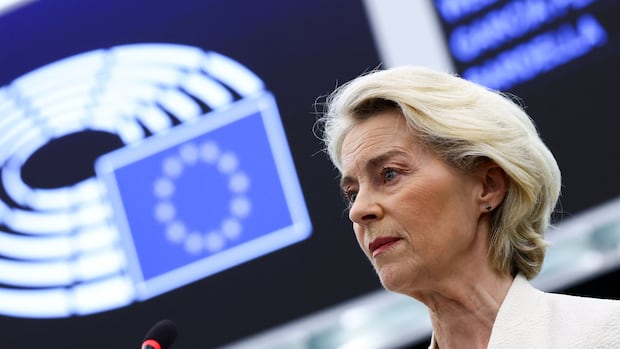
European Commission President Ursula von der Leyen spoke about the potential of the Canada-Europe relationship during her state of the European Union address, stating, ‘This partnership is not against anyone else, but for our collective strength.’
Fostering connections between citizens
In his speech, Carney suggested that Canada should participate in Erasmus+, the EU initiative supporting education, training, youth, and sports. He also indicated that Canada could broaden its involvement in Horizon Europe, the EU program that funds various research and innovation projects, which has a budget of approximately $150 billion for 2021-2027.
“We should strengthen our connections between people, enabling our youth to live, work, and study wherever they choose on either side of the Atlantic,” he noted.
Carney’s remarks followed European Commission President Ursula von der Leyen’s announcement in her state of the European Union address on Wednesday, indicating that Canada could become an “associate member” of the EU.
“I would like to collaborate with you to pave the way for Canada to be the first associate member of the EU,” von der Leyen stated, earning a standing ovation.
- What questions do you have regarding the proposed partnership between Canada and the EU? Send them to ask@cbc.ca.
Afterward, Carney acknowledged her, stood up, approached von der Leyen, and embraced her before waving to the chamber and returning to his seat.
Von der Leyen emphasized the necessity for both parties to “urgently reimagine” their partnership, moving beyond a mere free trade agreement.
Carney expressed his “welcome” for this ambition, though he preferred to refer to it as an “alliance for the future.”
“Canada and Europe should safeguard our strategic independence through extensive cooperation across a full spectrum of strategic capabilities,” he added.

Prime Minister Mark Carney indicates that Parliament will debate and vote on the structure of an alliance with the EU, highlighting this as a chance to enhance Canada’s strength, ‘sovereignty,’ and sustainability.
Prioritizing substance over terminology
Carney and his team have been minimizing the idea of labeling the new partnership as “associate member” since it was first mentioned in a Wall Street Journal article last week that referenced unnamed sources.
When questioned on the concept of Canada being an “associate member,” Carney stated that the “substance” of the deal is far more significant than the terminology used.
The prime minister clarified that Canada does not aspire to be a full EU member and that the terms of the alliance will be subject to debate and a vote in Canada’s Parliament.
Jonathan Wilkinson, Canada’s new ambassador to the EU, reiterated on Wednesday that Canada does not seek full EU membership in light of von der Leyen’s proposal.
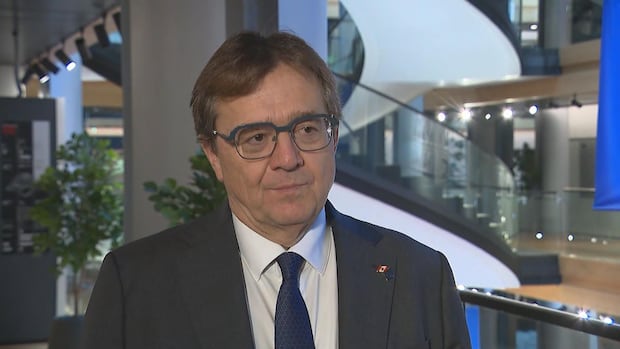
Jonathan Wilkinson, Canada’s incoming ambassador to the EU, asserts that ‘we’re not there yet’ regarding associate membership, stating that the focus is on achieving tangible results, with terminology to be addressed later.
Carney remarked, “There are many terms that have been used to describe what this new relationship could entail. We must reach a point where we clearly understand what we are defining.”
He added, “It’s about terminology; at the end of the day, there are various ways to describe it.”
Carney met with von der Leyen on Wednesday to discuss areas where both leaders believe they can strengthen their collaboration, including critical minerals, AI, defense, energy, and finance.