

Achieving the current position of Voyager 1 has taken almost five decades. However, light travels this distance in just one day.
The spacecraft has recently attained a significant milestone — exactly 16 billion miles.
“This signifies that it takes a full day for light or radio waves from Earth to reach Voyager,” stated Jason Rhodes, the lead scientist for astrophysics, heliophysics, and fundamental physics at NASA’s Jet Propulsion Laboratory.
“Additionally, it requires another full day for signals from Voyager to return to Earth.”
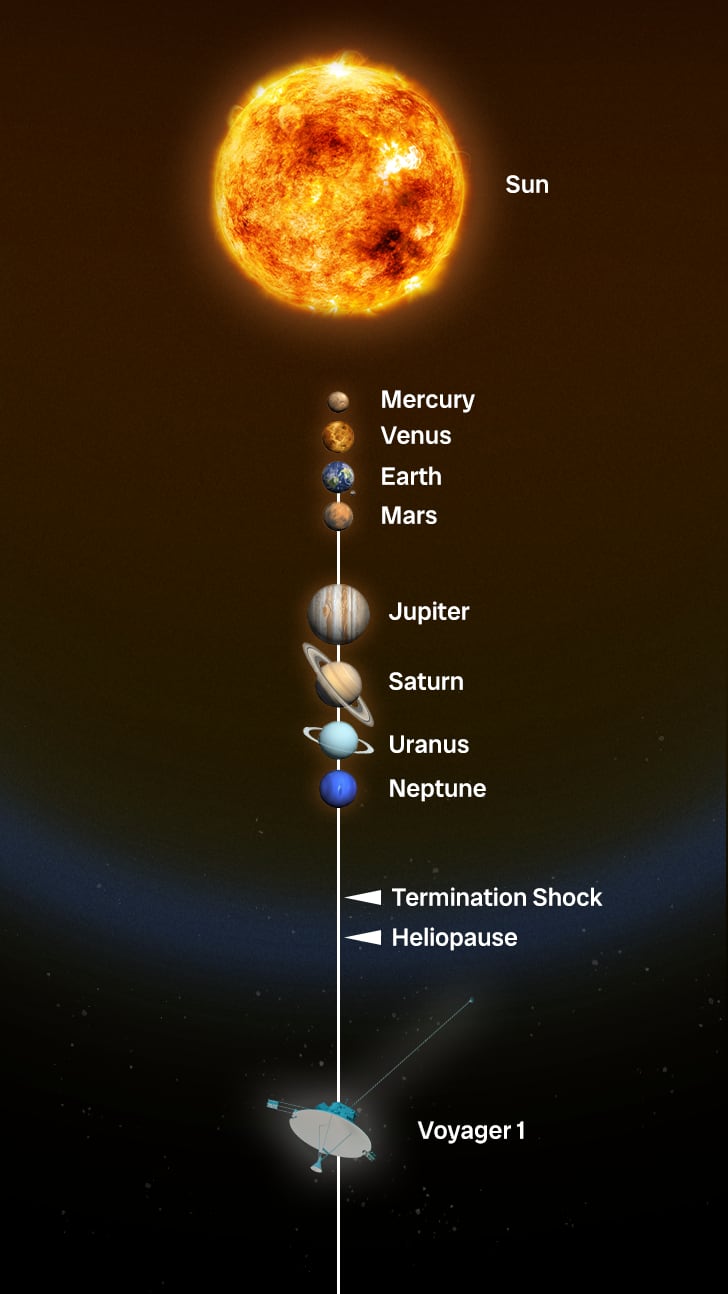
While not to scale, Voyager 1 has traveled an impressive distance over nearly 50 years. (CBC)
Voyager 1 was launched in 1977 with the mission to explore the gas giants of our solar system, namely Jupiter and Saturn. However, by 1998, it had surpassed these planets, becoming the most distant human-made object in existence. It entered interstellar space — the area just beyond the sun’s magnetic field known as the heliopause — in 2012, when it was 18 billion kilometers away. Currently, it is over 26 billion kilometers distant.
“When we discuss these vast distances, it truly highlights the enormity of space,” remarked Bethany Downer, a member of the communications team for the Hubble and James Webb space telescopes. “It’s quite remarkable that an object relatively small, which we built, is able to continue its journey indefinitely.”
-
Are we alone? Institute searching for alien signals is using a new way to answer that age-old question
-
A spacewalk to remember: Canadian astronaut Joshua Kutryk says seeing Earth ‘changed’ him
Still operational, still communicating
Although being a “light day” away might seem like an arbitrary measure, as there are no new physical barriers or changes to Voyager 1 itself, experts consider it significant because it remains operational and continues to communicate with Earth.

“It’s not functioning as extensively as it once did. Many of the onboard instruments that were used for scientific research are no longer operational,” Downer explained.
The power for Voyager 1 is derived from the heat produced by the natural decay of plutonium. As this power has diminished over nearly 50 years, most scientific instruments have been turned off, the latest being the LCEP, which measured low-energy charged particles. Currently, only two instruments remain active, one for detecting plasma waves and another for measuring magnetic fields.
“These instruments provide valuable data about star formation and reveal that the space between stars is not empty but filled with intriguing particles and physical phenomena that we had limited understanding of until Voyager,” Rhodes shared with CBC News from Pasadena, California.
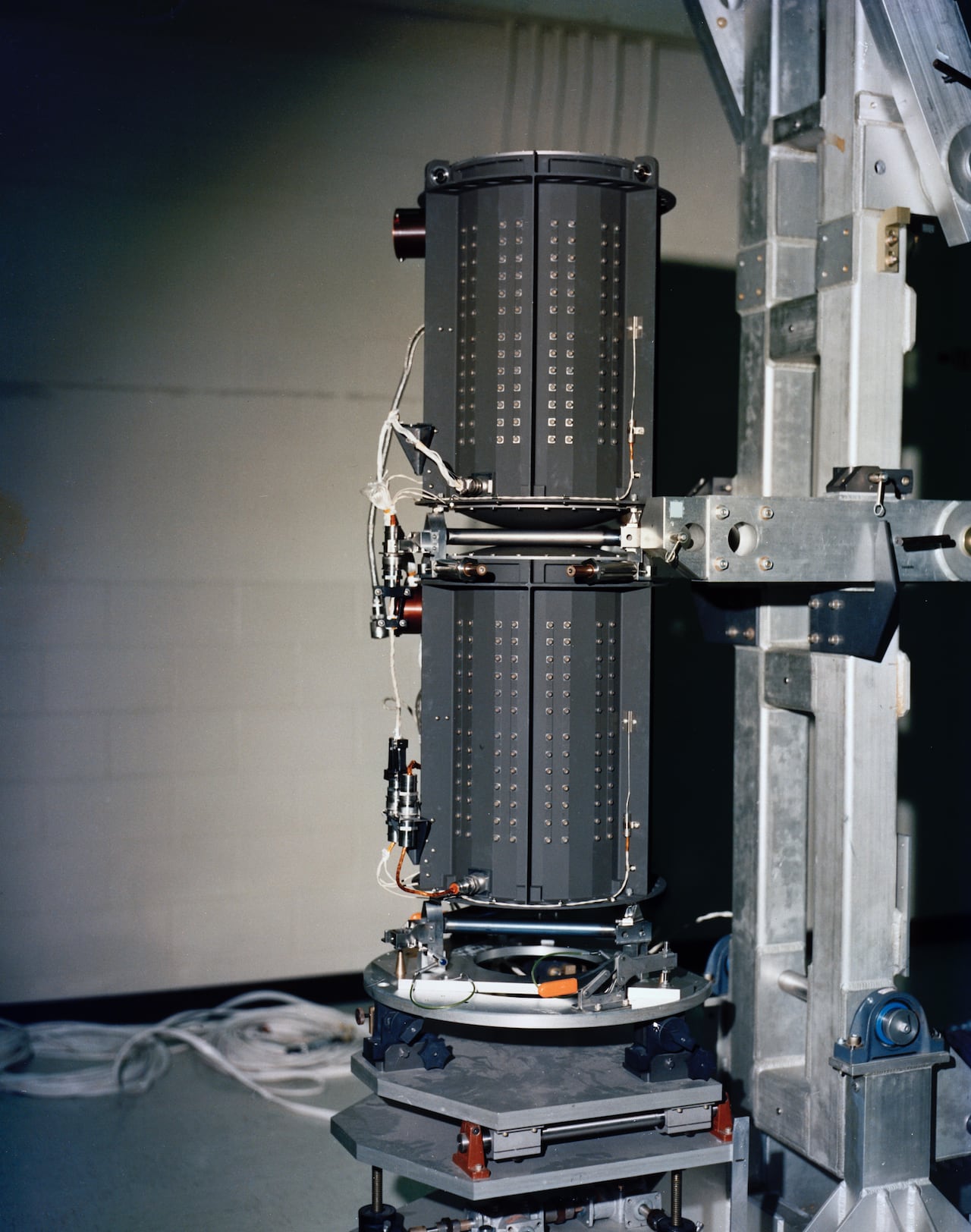
NASA’s Voyager probes are equipped with three radioisotope thermoelectric generators (RTGs), including the one illustrated here. The RTGs generate power for the spacecraft by converting heat from the decay of plutonium-238 into electricity. (NASA/JPL-Caltech)
These instruments relay information back to Earth through the deep space network, a collection of antennas situated at various locations worldwide dedicated to maintaining constant communication with spacecraft. Although the signals from Voyager 1 are weak, the desire to receive its messages remains strong.
“The most crucial message is: ‘I’m still operational, I’m still active,’” Downer conveyed to CBC News from St. John’s.
In motion but never forgotten
NASA anticipates that Voyager 1 (along with its counterpart Voyager 2, which was launched the same year but on a separate trajectory) will continue to send signals for another ten years. However, Rhodes notes that there is no definitive conclusion, as teams are working on energy-efficient methods to prolong its operational life.
Even without power, their missions will not conclude.
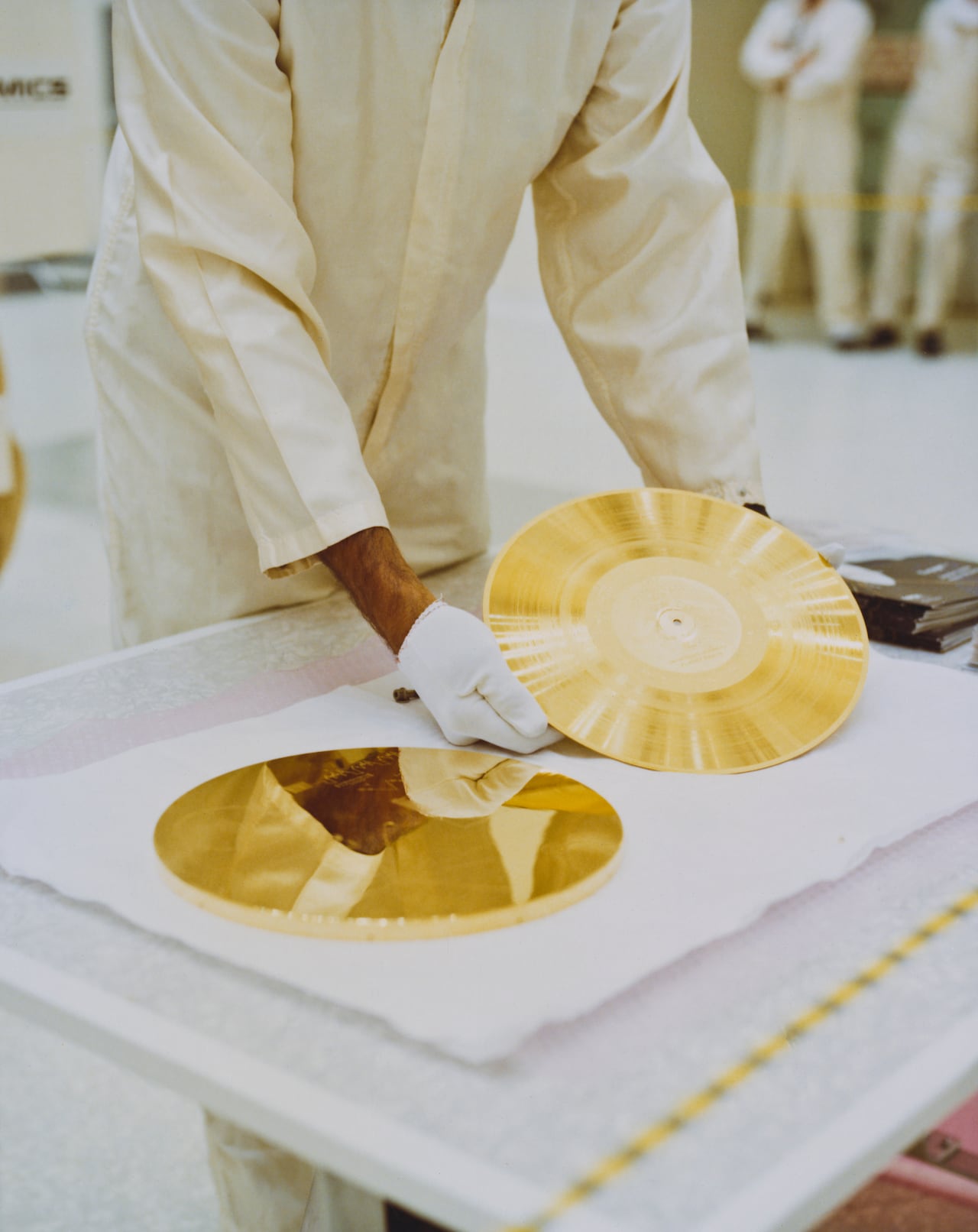
Both Voyager spacecraft carry a unique payload that serves as a snapshot of life and culture on Earth. (NASA/Hulton Archive/Getty Images)
“Both of them have a golden record,” Rhodes stated, “and it’s composed of gold because that’s a metal that resists tarnishing, rusting, and decay.”
Essentially a time capsule, these golden records encapsulate a variety of sounds from humanity, including greetings in 55 languages, music, and the natural sounds of Earth, such as thunder and the songs of humpback whales.
If you’re curious about how someone might play it, instructions are provided. If you’re pondering who might play it, they would need to think similarly to us.
Additionally, they carry a message in Morse code, as Downer noted: “Ad astra per aspera,” which translates to “To the stars, through hardships.”
As Voyager 1’s journey continues, it has already offered profound insights into our solar system, especially regarding our understanding of ourselves, highlighted by this image taken in 1990 from six billion kilometers away.

The Pale Blue Dot is a photograph of Earth taken Feb. 14, 1990, by NASA’s Voyager 1 at a distance of 3.7 billion miles (6 billion kilometers) from the Sun. (NASA/JPL-Caltech)
Referred to as the Pale Blue Dot, this photograph illustrates Earth as a minute dot illuminated by a beam of light. Requested by American astronomer Carl Sagan, he famously captured the essence of our insignificance in his book of the same name.
“Reflect again on that dot. That is here. That is home. That is us.”
Tag: rewrite-pending