

Ursula von der Leyen, the President of the European Commission, announced that Europe aims to extend an invitation for Canada to become an “associate member” of the European Union.
Prime Minister Mark Carney was present in the front row as von der Leyen emphasized essential aspects of enhanced collaboration between Europe and Canada during her address in Strasbourg, France.
In her state of the union speech, she urged both parties to “urgently reimagine” their partnership, advocating for progress beyond a mere free-trade agreement.
“I would like to collaborate with you to pave the way for Canada to be the first associate member of the EU,” von der Leyen stated on Wednesday, prompting a standing ovation.
Carney nodded in agreement, stood up, walked towards von der Leyen, and embraced her. He briefly waved to the assembly before retaking his seat.
“We share one ocean, one set of values, and a unified worldview,” she remarked. “Together, we will shape our common future — thank you for being here.”
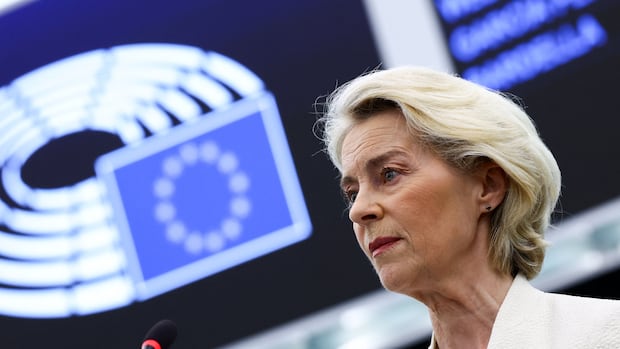
European Commission President Ursula von der Leyen highlighted the evolving global landscape and the potential of the Canada-Europe relationship in her state of the European Union address. ‘This is not a partnership against anyone else, but for our collective strength.’
Carney is visiting France this week to foster a stronger partnership with Europe, primarily concentrating on trade, defense, and people-to-people connections.
In her speech, von der Leyen expressed that Europe seeks to elevate its relationship with Canada to the “highest level possible.”
The idea of associate membership was introduced last week when the Wall Street Journal reported, based on sources, that Canada is evaluating the possibility of membership.
- Just Asking wants to know: What questions do you have regarding the EU and what “a unique alliance” might entail for Canada? Send us your questions before our September 19 show.
During the Toronto International Film Festival, Carney dismissed the report on Sunday, clarifying that Canada is not pursuing European Union membership but is instead aiming for a “unique alliance” with the economic bloc.
He is scheduled to speak at the European Parliament on Thursday, at the invitation of European Parliament President Roberta Metsola.

Prime Minister Mark Carney stated that Canada is ‘not looking to be a member of the European Union.’ However, if there were an interest in joining the EU, is it even feasible? Here are the facts.
On Wednesday, Carney received a ceremonial welcome at the European Parliament building, greeted by Metsola and von der Leyen.
As he entered the chamber, applause erupted, and he received a standing ovation following Metsola’s formal introduction.
“Mark, your attendance here signifies the lasting friendship shared between our peoples,” von der Leyen stated in her address, which lasted over an hour. “Our cultural, historical, and personal connections are deeply woven into the fabric of our societies.
“We view the world through a shared lens: from AI to climate change, from the Arctic to geopolitics. We have united on matters regarding Ukraine, defense, raw materials, and supply chains.”
Von der Leyen indicated that Europe and Canada aim to evolve from a free trade agreement to “an alliance for the future,” while enhancing collaboration on the Arctic, energy, critical minerals, and batteries.
EU representative downplays ‘associate’ term
The Prime Minister’s Office did not clarify the proposition for Canada to become an associate member of the EU, instead emphasizing von der Leyen’s other comments on forging a partnership.
“We appreciate President von der Leyen’s suggestion for Canada and the European Union to progress beyond the [free trade agreement] towards a future alliance,” a spokesperson stated.
“This represents a unique, constructive approach that we will define collaboratively.”
- Just Asking wants to know: What inquiries do you have about the EU and what “a unique alliance” could entail for Canada?Send us your questions before our September 19 show.
The term “associate member” lacks legal standing in the EU, and the bloc’s regulations state that only European nations may apply for membership.
Jonathan Wilkinson, Canada’s upcoming ambassador to the EU, played down von der Leyen’s suggestion, indicating that both sides are “a distance away” from agreeing on a term for a potential relationship.

Jonathan Wilkinson, Canada’s incoming ambassador to the European Union, states that ‘we’re not there’ after European Commission President Ursula von der Leyen suggested an avenue toward associate membership. ‘Our focus is on achieving results,’ he remarked, noting that the government will ‘eventually’ clarify the relationship’s description.
Wilkinson remarked, “There are various ways people have described what this could entail. We need to reach a point where we precisely know what we are characterizing.”
“It’s about terminology; ultimately, there are numerous ways to articulate it.”
He reiterated that Canada is “not aiming to be a member of the European Union.”
Conservative Leader Pierre Poilievre criticized Carney for being unclear after von der Leyen mentioned the “associate membership” term during her address.
“Conservatives are unequivocal: we endorse the long-standing free trade and NATO defense alliance with Europe,” he stated on X.
“However, no EU taxes, no EU regulations, and no EU open-border immigration policies should be imposed on Canadians.”
The article from the Wall Street Journal initially incited significant backlash from Poilievre, who claimed on social media on Sunday evening that Carney “could not be more disconnected.”
“We will NEVER be the 51st U.S. state,” Poilievre asserted. “And we will NEVER be the 28th EU state.”

Prime Minister Mark Carney at the State of the European Union address in Strasbourg, France, on Wednesday. (Justin Tang/The Canadian Press)
Carney remained in the chamber for over an hour after von der Leyen’s address, listening to speeches from other leaders of political parties.
Terry Reintke, leader of the Greens-European Free Alliance group in the European Parliament, which holds seven percent of the seats, opened her remarks by noting her hope to see Carney in the chamber again.
“You are very welcome in this house. I hope you are beginning to feel at home among the member states present here, as we look forward to welcoming you frequently,” Reintke stated.
- This week, Cross Country Checkup is asking: Is Canada’s future with the United States or Europe? What implications do you foresee if Canada strengthens its relations with the European Union? Share your thoughts here and we may feature your perspective or contact you for Sunday’s show.
Throughout the morning, Thomas Byrne, Ireland’s minister of state for European affairs, sat alongside Carney.
He began his speech by reflecting on their shared ancestry, noting that their grandfathers hailed from the same county in Ireland and both served in the Irish police force.
“Your presence today visibly symbolizes the strong bond shared between Canada and the European Union,” Byrne stated.
“Thank you, President von der Leyen. Your proposal significantly enhances the relationships between the European Union and our valued friend, Canada.”